
Do Hernia Belts Work? Can They Prevent or Fix a Hernia?
What Is a Hernia Belt?
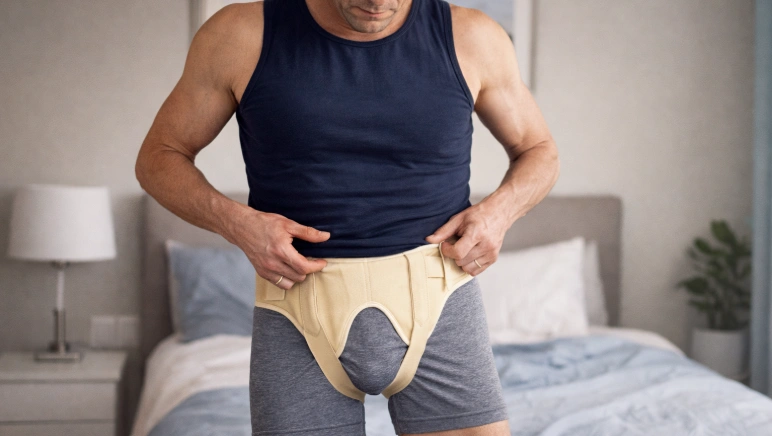
A hernia belt, sometimes called a truss or hernia support, is a garment designed to apply pressure over a hernia bulge.
It typically includes:
- A waistband
- Compression pads
- Adjustable straps
- Targeted support for the groin or abdominal wall
These devices are commonly marketed to men with inguinal hernias, though abdominal supports also exist for umbilical or incisional hernias.
Do Hernia Belts Fix a Hernia?
No.
A hernia belt does not repair the defect in the abdominal wall.
A hernia occurs when tissue pushes through a weakened area of muscle. External compression may temporarily reduce the bulge, but it does not close or heal the weakness.
Surgery remains the only definitive repair.
Can a Hernia Belt Prevent a Hernia From Getting Worse?
Not reliably.
There is no strong clinical evidence that hernia belts prevent a hernia from enlarging or progressing.
A hernia is a structural defect in the abdominal wall. While compression may temporarily reduce the bulge or relieve mild discomfort, it does not repair the underlying weakness.
A 2024 systematic review evaluating abdominal compression after hernia surgery found no reduction in recurrence rates or major complications compared to no compression. While abdominal binders may help with short-term postoperative pain, they did not improve long-term outcomes. Importantly, these studies evaluated postoperative compression — not belts used as a substitute for surgery.
In some cases, prolonged use may mask worsening symptoms and delay appropriate evaluation.
When Might a Hernia Belt Be Appropriate?
There are limited situations where a belt may be reasonable:
- Short-term symptom control before scheduled surgery
- Temporary support when surgery must be delayed
- Patients who are not surgical candidates
It should be used under medical guidance.
Can a Hernia Belt Prevent a Hernia From Forming?
No.
There is no evidence that wearing a hernia belt prevents a hernia from developing.
Preventive strategies are more appropriately focused on:
- Maintaining healthy weight
- Proper lifting technique
- Treating chronic cough or constipation
- Avoiding excessive abdominal strain
But some hernias occur due to natural tissue weakness and cannot be fully prevented.
Risks of Relying on a Hernia Belt
Using a belt instead of seeking evaluation can lead to:
- Enlargement of the defect
- Increased discomfort over time
- Risk of incarceration
- Risk of strangulation (rare but serious)
Warning signs requiring immediate evaluation:
- Sudden severe pain
- Firm, non-reducible bulge
- Nausea or vomiting
- Skin redness over the area
When Should You See a Hernia Surgeon?
Even if symptoms are mild, evaluation allows:
- Accurate diagnosis
- Determination of hernia type
- Discussion of watchful waiting vs. surgery
- Planning of minimally invasive options
Modern hernia repair techniques often allow same-day discharge and faster recovery compared to older surgical methods.
The Bottom Line
Hernia belts may provide temporary support, but they do not cure or prevent hernias.
If you notice a persistent bulge, even without significant pain, consultation with a hernia specialist is the safest way to understand your options.
Hernia Surgery & Treatment Resources
Learn about hernia symptoms, diagnosis, surgery, recovery, and when to seek medical care through educational resources from Hernia Innovations.