
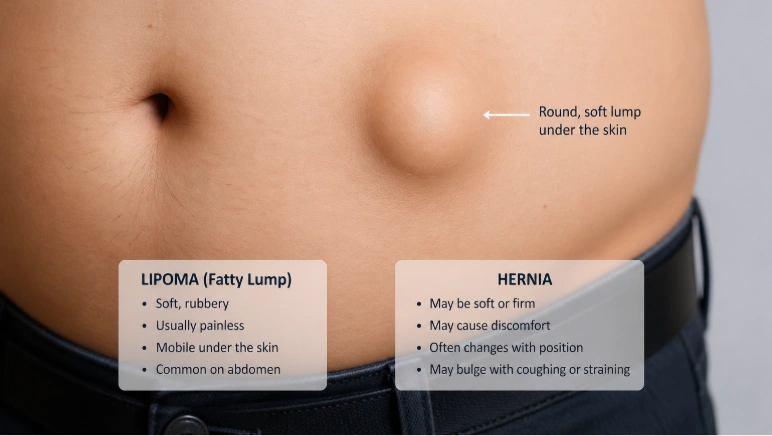
Hernia vs Tumor: How to Tell the Difference Between a Lump in the Abdomen
A lump in your abdomen or groin can be concerning. Many people assume a visible bulge is a hernia, but not every lump is caused by one. Some lumps may be tumors, cysts, lipomas, swollen lymph nodes, or other types of masses.
The main difference is what causes the lump. A hernia occurs when tissue pushes through a weak area in the surrounding muscle or connective tissue. A tumor is an abnormal growth of tissue that forms a mass.
Although certain characteristics may provide clues, you cannot reliably diagnose an abdominal lump based on appearance or touch alone. A medical evaluation can help determine the cause.
Is a Hernia the Same as a Tumor?
No. A hernia and a tumor are different conditions.
A hernia develops when tissue, fat, or part of an organ pushes through a weak area in the abdominal wall. A tumor is an abnormal mass of tissue that may be benign, meaning noncancerous, or malignant, meaning cancerous.
Both may appear as a lump in the abdomen or groin, but their causes, evaluation, and treatment are different.
What Is a Hernia?
A hernia occurs when an internal structure, often fatty tissue or part of the intestine, pushes through a weak area in the abdominal wall.
Common Hernia Locations
- Groin, including inguinal and femoral hernias
- Belly button, known as an umbilical hernia
- A previous surgical incision, known as an incisional hernia
- The diaphragm area, where a hiatal hernia may develop internally
A hiatal hernia generally does not cause a visible abdominal lump because it occurs inside the body near the diaphragm.
Typical Hernia Symptoms
A hernia may cause:
- A soft or noticeable bulge
- A lump that becomes more visible when coughing, lifting, or straining
- A bulge that becomes smaller when lying down
- Pressure, heaviness, or aching
- Pain or discomfort during physical activity
- A pulling or burning sensation near the affected area
Some hernias are reducible, meaning the bulge may become smaller when lying down or may be gently moved back into place.
Do not repeatedly press on a lump that is painful, firm, discolored, or tender.
What Is a Tumor?
A tumor is an abnormal mass of tissue. Tumors may be benign or malignant.
Unlike a hernia, a tumor does not involve tissue pushing through a weak area in the abdominal wall. It develops from abnormal cell growth within the tissue itself.
Possible Tumor Characteristics
A tumor may:
- Feel firm or hard
- Remain present regardless of position
- Stay the same when coughing or straining
- Grow gradually over time
- Cause pain or remain painless
- Feel fixed beneath the skin
These characteristics do not confirm that a lump is a tumor. Cysts, lipomas, enlarged lymph nodes, infections, and other conditions may also cause a persistent mass.
Key Differences Between a Hernia and a Tumor
These differences may provide useful clues, but they are not enough to make a diagnosis on your own.
Can a Hernia Feel Like a Lump?
Yes. Many hernias are first noticed as a lump or bulge in the abdomen or groin.
People may describe:
- A ball or area of swelling that appears during activity
- A bulge that becomes more noticeable when standing
- A lump that becomes smaller while resting
- Pressure or heaviness rather than sharp pain
- Discomfort when lifting, coughing, or bending
Hernias are a common cause of a visible abdominal or groin bulge, but other medical conditions can look similar.
When Might a Lump Not Be a Hernia?
Not every abdominal or groin lump is a hernia.
Other possible causes include:
- Lipomas, which are fatty growths beneath the skin
- Enlarged lymph nodes
- Cysts or fluid-filled sacs
- Abscesses or infections
- Scar tissue
- Hematomas or collections of blood
- Tumors of the abdominal wall or deeper tissues
A lump that is firm, fixed, steadily growing, or present regardless of activity should be evaluated by a healthcare provider.
Can a Hernia Feel Hard?
A hernia may sometimes feel firm, particularly if tissue becomes trapped, swollen, or inflamed.
A hard lump does not automatically mean it is a tumor. However, a painful or firm bulge that does not become smaller when lying down may indicate an incarcerated or strangulated hernia and should be evaluated promptly.
Warning Signs to Take Seriously
Schedule a medical evaluation if you notice:
- A new or unexplained lump
- A lump that does not go away
- A mass that is steadily growing
- Increasing pain or tenderness
- Redness or warmth near the lump
- Changes in the appearance or texture of the skin
- A bulge that has become harder or more difficult to reduce
Seek immediate medical care for:
- Severe or sudden pain
- Nausea or vomiting
- Abdominal swelling
- Fever with a painful bulge
- A lump that becomes firm, dark, red, or extremely tender
- An inability to pass gas or have a bowel movement
A hernia that becomes trapped or loses its blood supply may require emergency treatment.
How Do Doctors Diagnose a Hernia vs. a Tumor?
A physical examination is usually the first step.
Your healthcare provider may evaluate:
- The location and size of the lump
- Whether it changes when you stand, cough, or strain
- Whether it becomes smaller while lying down
- Whether it is soft, firm, movable, or fixed
- Whether it causes pain or tenderness
- How long it has been present
- Whether it has changed in size
Imaging may be recommended when the examination does not clearly identify the cause.
Possible tests include:
- Ultrasound for certain superficial lumps or suspected abdominal-wall hernias
- CT scan for deeper, complex, or unclear abdominal masses
- MRI for certain complex or uncertain cases
- Additional testing or biopsy if a tumor is suspected
Imaging helps distinguish between a hernia, tumor, cyst, enlarged lymph node, or another type of mass.
How Is a Hernia Treated?
Hernia treatment depends on:
- The type of hernia
- Its size and location
- Whether it is causing pain
- Whether it is growing
- Its effect on daily activity
- The risk of complications
- The patient’s overall health
Monitoring may be appropriate for certain hernias that are not causing significant symptoms.
Surgical repair may be recommended when a hernia causes pain, grows larger, limits activity, or carries a higher risk of complications.
Depending on the individual case, repair may be performed using:
- Open surgery
- Laparoscopic surgery
- Robotic-assisted surgery
A hernia surgeon can explain which approach may be appropriate.
How Is a Tumor Treated?
Tumor treatment depends on:
- The type of tumor
- Its location and size
- Whether it is benign or malignant
- Whether it is growing
- Whether it affects nearby tissue
- The patient’s overall health
Treatment may include:
- Monitoring
- Additional imaging
- Biopsy
- Surgical removal
- Oncology evaluation
- Other specialized treatment
Because hernias and tumors require different treatment, an accurate diagnosis is essential.
When Should You See a Specialist?
You should consider scheduling an evaluation if:
- The lump is new
- The lump is changing or growing
- You have pain, pressure, or discomfort
- The bulge appears during lifting or straining
- The lump does not go away when lying down
- You are unsure whether the lump is a hernia
- A previous hernia has returned
A hernia specialist can examine the area and determine whether imaging or treatment may be needed.
When Should You Have an Abdominal Lump Evaluated?
A hernia and a tumor can both appear as a lump, but they are different conditions.
A hernia may become more noticeable during coughing, lifting, or straining and may become smaller when lying down. A tumor or other mass may remain present regardless of movement or position.
These differences may provide clues, but they cannot confirm the cause of a lump.
Do not rely on appearance alone. A proper medical evaluation is the safest way to determine what is causing the lump and whether treatment is necessary.
Not sure whether your lump is a hernia? Schedule an evaluation with a hernia specialist. A physical examination and, when appropriate, imaging can help provide clarity and guide the next steps.
Frequently Asked Questions
Is a hernia the same as a tumor?
No. A hernia occurs when tissue pushes through a weak area in the abdominal wall. A tumor is an abnormal mass of tissue. Both may cause a lump, but they require different evaluation and treatment.
Can a hernia feel hard?
A hernia may sometimes feel firm, especially if tissue becomes trapped or swollen. A painful, firm bulge that does not become smaller when lying down should be evaluated promptly.
Can a doctor tell whether a lump is a hernia by touching it?
A physical examination may help identify a hernia, particularly when the lump changes with coughing, straining, or position. Imaging may be needed when the cause is uncertain.
Can an ultrasound tell the difference between a hernia and a tumor?
An ultrasound can help evaluate certain superficial lumps and suspected abdominal-wall hernias. Depending on the location and findings, a provider may recommend CT, MRI, or additional testing.
Does a lump that moves mean it is a hernia?
Not necessarily. Some hernias change with pressure or position, but other types of lumps may also move beneath the skin. A healthcare provider should evaluate any unexplained mass.
Can a tumor look like a hernia?
Yes. A tumor or another type of mass may sometimes resemble a hernia. A physical examination and imaging can help determine the difference.
Hernia Surgery & Treatment Resources
Learn about hernia symptoms, diagnosis, surgery, recovery, and when to seek medical care through educational resources from Hernia Innovations.